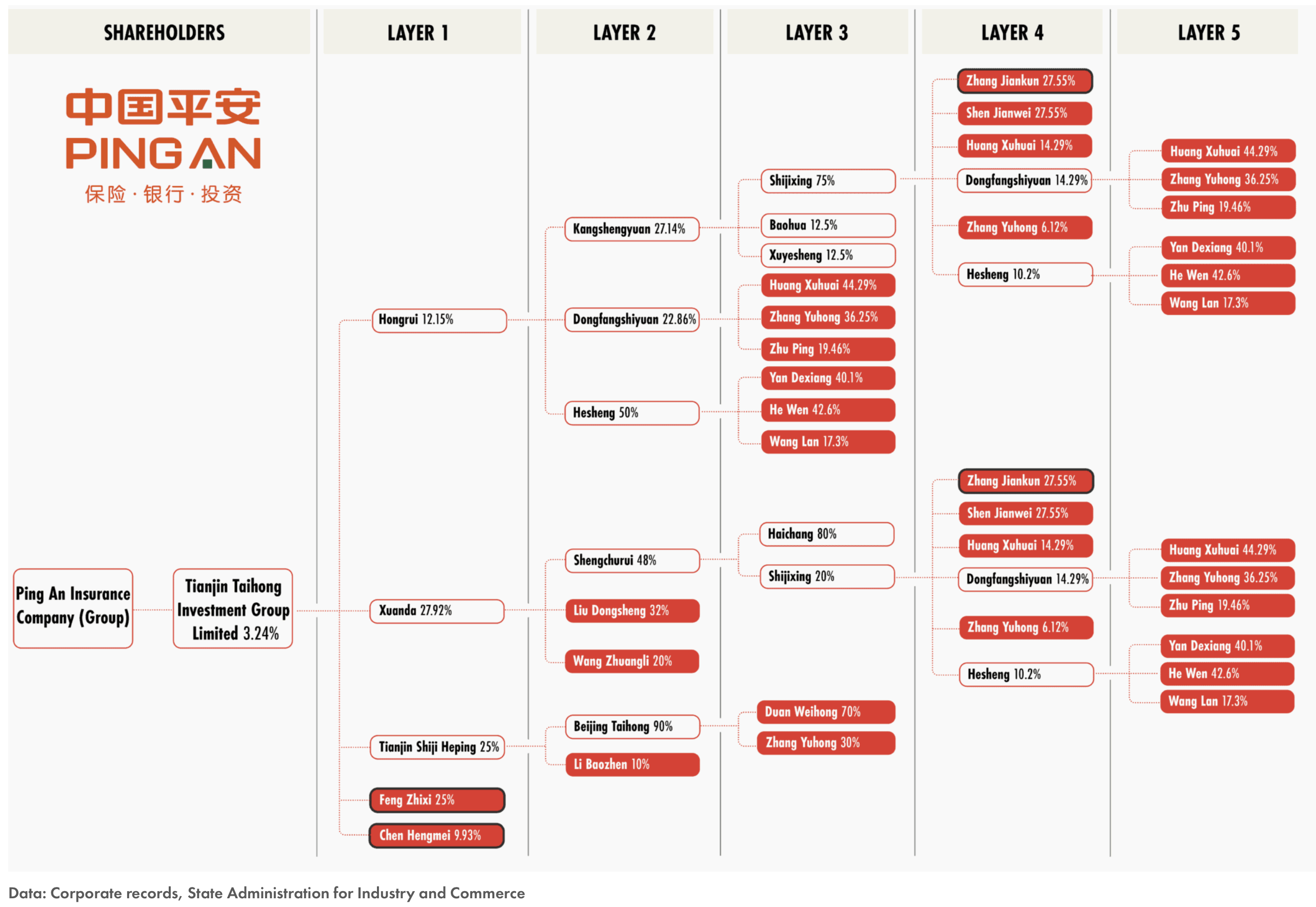
n 2012, while reporting for The New York Times, I spent over a year manually mapping thousands of corporate records to expose the hidden wealth of China's then-Prime Minister Wen Jiabao. The investigation revealed a family fortune exceeding $2.7 billion and earned me the 2013 Pulitzer Prize for International Reporting—but it also revealed a fundamental problem with investigative journalism in the digital age.
While the global economy moves at the speed of light, investigative research was still moving at the speed of paper.
This experience led me to co-found WireScreen in 2019. We built the tool I wish I had: a platform that helps pierce the corporate veil in seconds, not months. But a tool is only as good as the methodology behind it. This playbook shares investigative principles I've developed over 15 years covering China—techniques that remain valuable whether you're using WireScreen, other data platforms, or conducting traditional records research.
The Investigator's Mindset
Don't just look for data. Look for patterns of concealment.
1. The "Shell Game" is the Signal
Complexity is rarely accidental. If a company ownership structure looks like a bowl of spaghetti—passing through three holding companies, a BVI entity, and a Singaporean shell—that's not just a business strategy; it's often a strategy of deception.
The Rule: The more layers you peel back, the closer you are to the truth.
The Move: Bypass the layers and identify the Ultimate Beneficial Owner (UBO).
2. Influence is Often as Important as Income
Western journalists often judge a company's size by its revenue. In opaque markets, that's a mistake. The real measure of power is total controlled assets—what we at WireScreen call "Controlled Capital."
The Concept: A firm might report modest revenue, but if it sits at the top of a pyramid controlling dozens of subsidiaries, its true weight is massive. Controlled Capital is WireScreen's proprietary metric that calculates the total value of a company's downstream investments and holdings.
The Rule: If a "small consulting firm" has $500,000 in revenue but $2 billion in Controlled Capital, it's not a business—it's a vehicle for power
The Move: In WireScreen, check the "Controlled Capital" figure and Total Investments count. A high number here signals that the entity wields far more influence than its revenue suggests. In traditional research, map all subsidiary relationships and shareholdings to calculate this yourself.
3. The Network Is the Story
A company profile is a static image. The truth is in the connections.
The Rule: Evasion rarely happens in isolation. It happens with the aid of business networks.
The Move: Don't just vet the person. Vet their network. Who do they repeatedly co-invest with? Bad actors hunt in packs.
CASE STUDIES: Real-World Investigations
How top investigative teams used data to break global stories.
Note: These case studies describe publicly reported investigations. WireScreen was consulted as a data source in some of these investigations alongside other research methods and tools.
CASE STUDY A: The Military Connection (ASML)
The Outlet: Nieuwsuur (Dutch News Hour)
Publication Date: December 2024
The Scoop: ASML, one of the largest tech companies in the world, was shipping chip machines to "civilian" Chinese clients. The investigation revealed these clients had connections to the Chinese military.
The Methodology:
The Ownership Trace: Corporate records showed a client named "GTA Semiconductor" was owned by CEC (China Electronics Corporation), a State-Owned Enterprise designated by the Chinese government as a military-industrial group. CEC appears on U.S. sanctions lists.
The Human Link: The investigation identified leadership connections to research institutes involved in military technology development.
The Result: Dutch reporters documented that "civilian" exports were linked to the military-industrial complex.
Data Sources Used: Nieuwsuur consulted WireScreen and Dutch firm Datenna for corporate background checks, alongside Chinese import/export data and public corporate registries.
CASE STUDY B: The Sanctions Loophole (Nvidia)
The Outlet: The New York Times Publication Date: October 2024
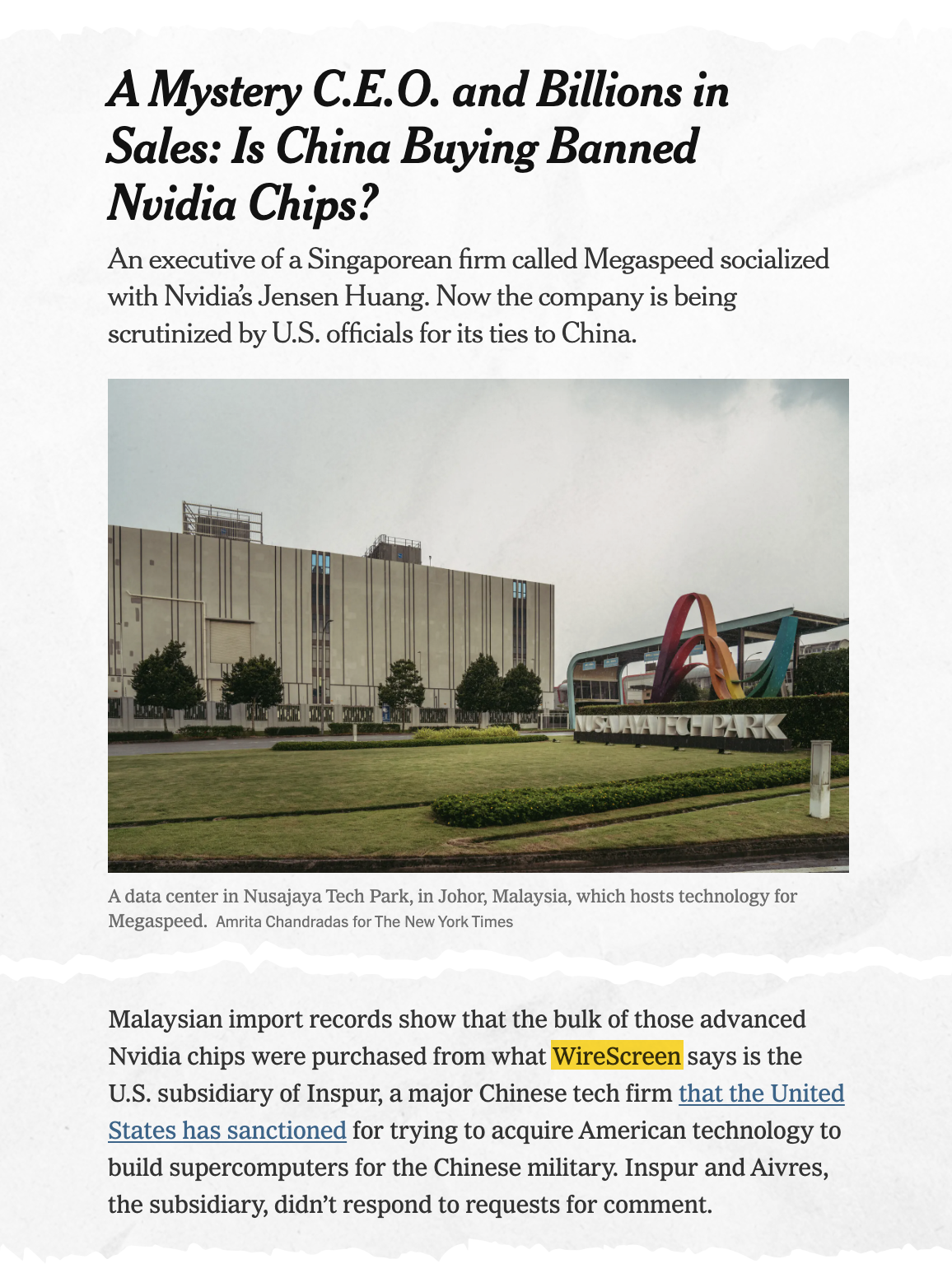
The Scoop: An unknown Singaporean firm, "Megaspeed," bought nearly $2 billion in Nvidia chips. U.S. authorities suspected these chips were being diverted to China.
The Methodology:
The "Spin-Off" Discovery: Corporate records revealed Megaspeed was created in 2023 by splitting off from 7Road, a Chinese gaming company with state-backed investors.
The "Cutout" Discovery: Trade records showed they bought chips from Aivres Systems, a California-based subsidiary of Inspur—a Chinese company previously sanctioned for supplying the Chinese military with supercomputing hardware.
The Regulatory Gap: Because Aivres operates as a U.S. company, it could lawfully purchase Nvidia products, exploiting a loophole that separated the American entity from its sanctioned parent.
The Result: The investigation exposed a regulatory blind spot where a U.S. subsidiary was used to potentially circumvent sanctions on its Chinese parent company.
Data Sources Used: Trade data from ImportGenius, corporate registrations, site visits across four countries, and interviews with over 30 people.
CASE STUDY C: The "Ghost" Supply Chain (US Drone Co.)
The Scenario: A major U.S. manufacturer needed to vet 14 Chinese suppliers of camera and sensor parts.
Note: This is a composite example based on typical due diligence work, not a specific publicly-reported case. Client details have been anonymized.
The Challenge: The vendor list was complex. Many firms operated under English-only websites with no official Chinese names, or listed addresses in Hong Kong to appear "offshore."
The Methodology:
Identity Resolution: Matching vague English names to official Social Credit Codes (China's corporate ID system).
Ownership Tracing: Several "Hong Kong" firms were revealed as Mainland-owned entities operating out of Shenzhen.
The "Ghost" Hunt: For suppliers with unclear identities, investigators triangulated using address matches and cross-referenced product listings to find registered Chinese entities.
Typical Risk Findings in Supply Chain Audits:
Entities appearing on the Specially Designated Nationals (SDN) list
Companies officially designated by the Pentagon as "Chinese Military Companies"
Suppliers with documented relationships to PLA or sensitive Chinese government programs
"Rebranded" suppliers sharing registration details with sanctioned entities
This type of analysis typically requires: Corporate registry access, sanctions list screening, trade data, beneficial ownership tracing, and network analysis tools.
The Anatomy of an Investigation
Common scenarios you will encounter.
Scenario 1: The "Rebranded" Supplier
The Pitch: A global brand claims its supply chain is clean—they dropped the sanctioned supplier and signed a "new" one.
The Reality Check: The "new" supplier may be the same entity with a fresh coat of paint.
Review registration dates relative to sanctions timing
Examine relationship networks
Flags:
New company registered shortly after sanctions
Shared contact information or addresses
Overlapping ownership or management
Similar product offerings and customer bases
Scenario 2: The "Civilian" University
The Pitch: A U.S. university partners with a Chinese academic institution on "climate research" or another seemingly benign topic.
The Reality Check: The partner institution may have undisclosed defense industry connections.
The Investigation Approach:
Audit the institution's investment portfolio
Research spin-off companies and technology transfer agreements
Check if the university appears on "Civil-Military Fusion" lists
Review faculty and leadership backgrounds
Flags:
University-owned companies with defense applications
Research partnerships with known military entities
Faculty with PLA backgrounds
Participation in military-civil fusion programs
The "Red Team" Checklist
Before you publish, stress-test your findings.
[ ] The UBO Test: Have I identified the actual human being at the top, or am I still looking at a holding company?
[ ] The Proxy Check: Is the listed "Owner" a 24-year-old with no other business footprint? (Classic sign of a nominee director)
[ ] The "Controlled Capital" Test: Does this small firm control disproportionate assets? (Indicates hidden power)
[ ] The Address Verification: Have I verified the registered address? (Is it a PO Box, a prestigious office tower, or a dilapidated storefront?)
[ ] The "Former" Life: Did executives previously work for military, intelligence, or regulatory agencies?
[ ] The Network Test: Who else is in this company's investment network? Do they have problematic connections?
[ ] The Timeline Test: Do registration dates, name changes, or restructurings coincide suspiciously with sanctions or investigations?
[ ] The Multiple Source Test: Can I confirm this finding through at least two independent data sources?
Pro-Tip: Verification & Citing
Data platforms point you to connections; original documents prove them.
When you find a significant connection through corporate research, always:
Locate the source document: Most data platforms (including WireScreen) provide links to original filings
Download and archive: Get the actual registry filing, SEC document, or trade record
Cite the primary source: Reference the original public record (e.g., "according to SAMR registry filing #123456" or "SEC Form 10-K filed March 2024")
Verify through multiple channels: Cross-reference findings with other databases, trade records, or official sources
Document your methodology: Be transparent about how you found the information
Why this matters: Original documents make your reporting bulletproof against legal challenges and build reader trust.
Tools and Resources
Corporate Registry Research:
China: SAMR (State Administration for Market Regulation)
Hong Kong: Companies Registry
Singapore: ACRA (Accounting and Corporate Regulatory Authority)
United States: SEC EDGAR, state business registries
Global: OpenCorporates, BVD/Orbis
Sanctions and Entity Lists:
U.S. Specially Designated Nationals (SDN) List
Entity List (U.S. Department of Commerce)
Chinese Military Companies List (DoD)
OFAC Sanctions Lists
Trade Data:
ImportGenius
Panjiva
Custom databases (varies by country)
Due Diligence Platforms:
WireScreen (China-focused)
Various global compliance platforms
Share:
David is the Co-Founder and CEO of WireScreen. A two-time Pulitzer Prize-winning investigative journalist who previously worked at The New York Times, David has more than 15 years of experience covering China and using corporate records.

.png)